You should pay attention to this
The devices are intended for industrial applications.
Machine builders must employ qualified personnel. Qualified personnel are people who have been trained to transport, install, commission, and operate electrical drives.
- Transport, storage, unpacking: Only by personnel with knowledge of handling electrostatically sensitive components.
- Mechanical installation: Only by personnel with mechanical expertise.
- Electrical installation: Only by personnel with expertise in electrical engineering.
- Basic tests / setup: Only by personnel with expertise in electrical engineering and drive technology.
The qualified personnel must know and observe ISO 12100 / IEC 60364 / IEC 60664 and national accident prevention regulations.
Read the documentation!
Read the available documentation before installation and commissioning. Improper handling of the devices can cause harm to people or damage to property. The operator of systems using the drive system must ensure that all personnel who work with the drive read and understand the manual before using the drive.
Check Hardware Revision!
Check the Hardware Revision Number of the product (see product label). Hardware Revsion Number of MKD-C and MKD-N can differ from each other. This number is the link between your product and the manual. The product Hardware Revision Number must match the Hardware Revision Number on the cover page of the manual.
Pay attention to the technical data!
Adhere to the technical data and the specifications on connection conditions. If permissible voltage values or current values are exceeded, the devices can be damaged. Unsuitable motor or wrong wiring will damage the system components. Check the combination of drive and motor. Compare the rated voltage and current of the units.
Perform a risk assessment!
The manufacturer of the machine must generate a risk assessment for the machine, and take appropriate measures to ensure that unforeseen movements cannot cause injury or damage to any person or property. Additional requirements on specialist staff may also result from the risk assessment.
The manufacturer should define periodic checks of the electrical components and application.
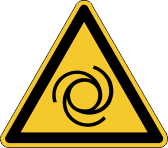
Automatic Restart!
|
The drive might restart automatically after power on, voltage dip or interruption of the supply voltage, depending on the parameter setting. If the parameter DRV.ENDEFAULT for one MKD-N is set to 1, then place a warning sign to the machine (Warning: Automatic Restart at Power On) and ensure, that power on is not possible, while humans are in a dangerous zone of the machine. In case of using an undervoltage protection device, you must observe EN 60204-1:2006 chapter 7.5 . |
Observe electrostatically sensitive components!
The devices contain electrostatically sensitive components which may be damaged by incorrect handling. Electrostatically discharge your body before touching the device. Avoid contact with highly insulating materials (artificial fabrics, plastic film etc.). Place the device on a conductive surface.
Hot surface!
|
|
Risk of minor burns! Drives may have hot surfaces during operation. The housing can reach temperatures above 80 °C. Measure the temperature and wait until the housing has cooled down below 40 °C before touching it. |

Earthing!
|
|
Risk of electric shock! Ensure that the drive is safely earthed to the PE (protective earth) busbar in the switch cabinet. Without low-resistance earthing personal protection is at risk. |
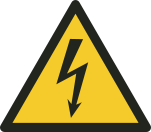
Leakage Current!
Since the leakage current to PE is more than 3.5 mA, double the PE connection or use a connecting cable with a cross-section >10 mm² to be compliant with IEC 61800-5-1.
Deviating measures according to regional standards might be possible.
Residual current protective or monitoring devices!
MKD-C with MKD-N can cause a d.c. current in the protective earthing conductor. Where a residual current-operated protective (RCD) or monitoring (RCM) device is used for protection in case of direct or indirect contact, only an RCD or RCM of Type B is allowed on the supply side of MKD-C.
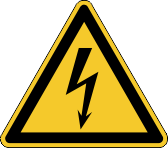
Lethal voltages!
|
The equipment produces high electric voltages up to 900V. Lethal danger exists at live parts of the device. Do not open or touch the equipment during operation. Keep the IP 54 cabinet doors closed during operation. Built-in protection measures such as insulation or shielding may not be removed. Work on the electrical installation may only be performed with switched off mains supply, and secured against restart. Never undo any electrical connections to the MKD while it is live. There is a danger of electrical arcing with damage to contacts and personal injury. Wait at least 5 minutes after disconnecting the product from the supply voltages before touching potentially live sections of the equipment or removing any connections. Ensure the MKD-N DC-Bus link cover is installed on the last MKD-N before switching on mains power. |
High noise pollution!
|
|
Fans generate noise of up to |

Functional Safety
The STO safety implementation on the MKD is certified. The brake interruption input can be used to realize an SBC function. The user has to do an assessment of the safety functions according to EN13849 or EN 62061.
|
Never modify the drive! |
|
|
|
Never open the cover of the drive, as the electronic components installed there generate dangerous high voltages. Even after disconnection from the mains, the components often still carry high voltage. |
Kollmorgen shall not be held accountable for any defects, malfunctions or degradations resulting from users opening up the device. In case of damage or malfunction, send the drive for repair or replacement.


